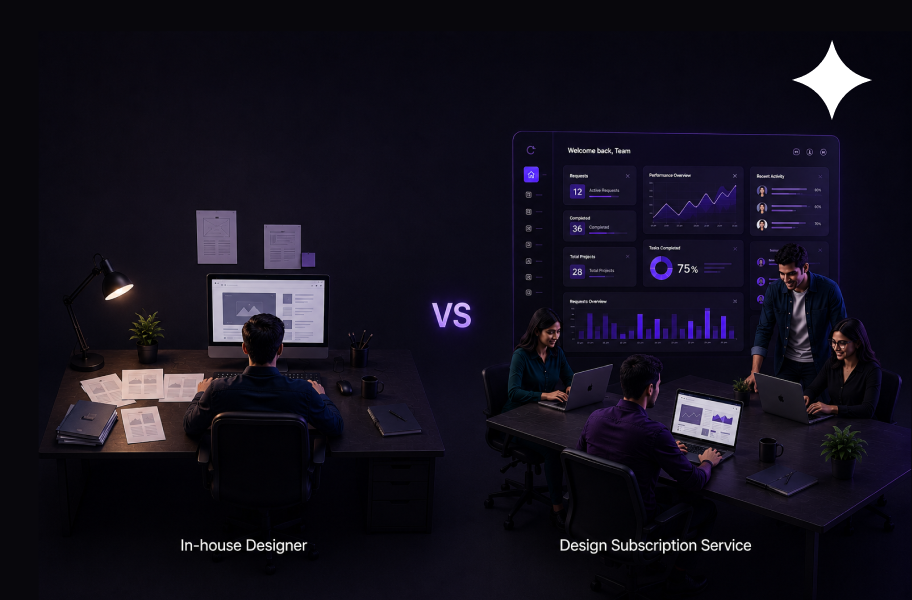
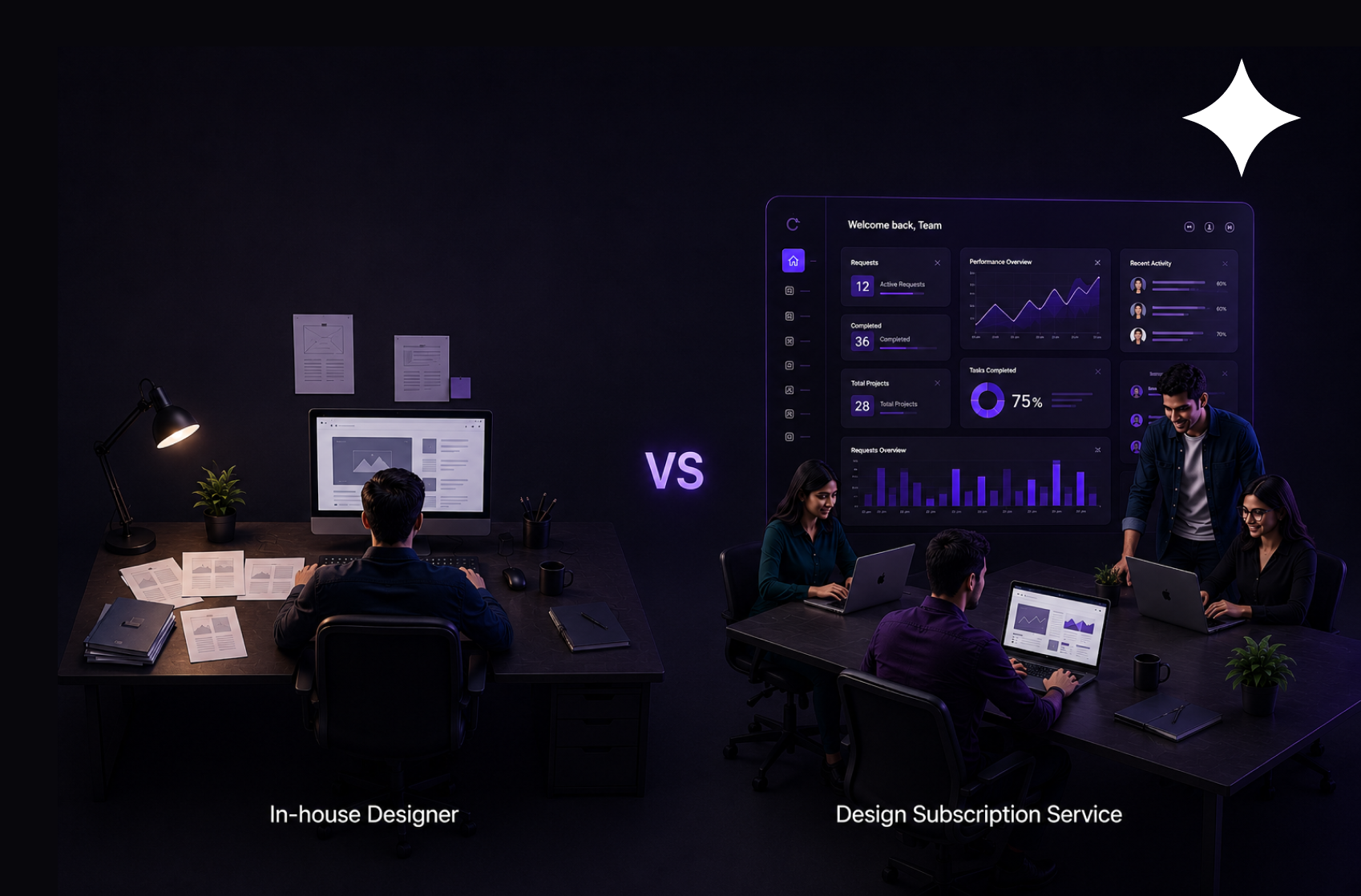
Design Subscription vs. Hiring an In-House Designer: Which Saves More Money?
Design demand rarely stays predictable.
One week, your marketing team needs a few social media graphics. The next, you are preparing paid ad creatives, a sales deck, a landing page, email templates, and updates to your brand assets; all at the same time.
For growing businesses, this creates an important financial question: should you hire an in-house designer or use a design subscription?
At first glance, hiring someone internally may seem like the natural next step. You have a designer available during working hours, they become familiar with your brand, and they can collaborate with your team.
But salary is only one part of the real cost.
Recruitment, software, employee benefits, management time, equipment, training, and limited individual capacity can make the cost of hiring an in-house designer significantly higher than expected.
A design subscription takes a different approach. Instead of adding permanent headcount, businesses pay a predictable fee for ongoing creative support.
So, which model actually saves more money?
Let’s compare the real costs.
What Is a Design Subscription?
A design subscription is an ongoing creative service where a business pays a fixed monthly fee for design support.
Rather than hiring an employee or requesting individual project quotes, your team submits design requests through an organised workflow. Depending on the service and plan, requests may include marketing graphics, branding assets, website design, UI/UX, presentations, email templates, illustrations, and motion design.
With Orra, businesses can queue unlimited design requests and revisions while work is completed according to the number of active requests included in their selected plan.
The model is designed for companies that need consistent creative output without increasing internal headcount.
The financial advantage is simple: predictable design costs.
You know what your creative support costs each month, making budgeting and resource planning considerably easier.
What Does Hiring an In-House Designer Really Cost?
When companies compare an in-house designer vs design subscription, they often begin with salary.
That comparison is incomplete.
The actual cost of an employee extends beyond the amount shown on an employment offer.
Recruitment and Hiring Costs
Finding the right designer takes time.
Your team may need to write job descriptions, advertise the role, review portfolios, conduct interviews, complete practical assessments, negotiate compensation, and manage onboarding.
Even when recruitment is handled internally, senior employees spend valuable working hours on the hiring process.
If the selected candidate leaves after a few months, the process starts again.
A design subscription removes most of this recruitment cycle. You are purchasing access to an established creative workflow rather than building one employee relationship from zero.
Salary and Employee Overhead
A full-time designer requires a recurring salary regardless of whether your design workload is unusually high or temporarily quiet.
Depending on your location and employment structure, additional in-house designer costs may include benefits, payroll expenses, paid leave, insurance, bonuses, and other employee-related commitments.
There is also a long-term financial obligation.
Your business is not simply purchasing completed designs. You are paying to maintain permanent creative capacity.
For organisations with stable and highly specialised design requirements, that investment may make sense. For teams with fluctuating workloads, however, the economics can become inefficient.
Equipment and Design Software
Professional designers need the right tools.
A capable computer, additional monitors, storage, licensed fonts, stock resources, collaboration platforms, and professional design software can all contribute to your design team overhead.
Software costs may appear small individually, but they become recurring operational expenses.
There is also responsibility for hardware upgrades, troubleshooting, access management, and maintaining an effective digital workspace.
With an outsourced design subscription, the creative provider manages its own production infrastructure.
Training and Management Time
An employee requires management.
Someone needs to assign priorities, review work, provide feedback, discuss deadlines, monitor capacity, and support professional development.
A new designer also needs time to understand your brand, products, audience, internal processes, and communication style.
This does not mean an in-house designer cannot become highly efficient. In fact, a strong internal employee can develop deep brand knowledge.
The question is how much time and money the business invests before reaching that level of efficiency.
Design Subscription vs. In-House Designer: A Cost Comparison
The difference becomes clearer when you look beyond the monthly invoice.
The cheapest option still depends on how your business works.
However, companies should compare the total cost of creative capacity, not simply salary against subscription pricing.
That is where the financial difference often becomes visible.
The Hidden Cost of Relying on One Designer
Hiring one talented designer does not automatically give your business a complete creative department.
A graphic designer may be excellent at marketing campaigns but have limited UI/UX experience.
A product designer may understand complex user journeys but may not specialise in motion graphics.
A brand designer may build a strong visual identity but may not be the right person to develop Webflow pages.
Modern businesses often need multiple creative capabilities.
Orra supports a broad range of design requirements, including graphic design, branding, website design, product UI/UX, motion design, email templates, and Webflow or Framer development.
Trying to find one employee who performs every discipline at an expert level can be difficult—and expensive.
If additional freelancers or agencies are still required after hiring internally, your total design expenditure increases further.
What Happens When Design Demand Increases?
Capacity is one of the most important financial considerations in the design subscription vs in-house designer debate.
Imagine your business is preparing for a major product launch.
Marketing needs paid ad variations.
Sales needs a presentation.
The product team needs new interface screens.
Your website requires landing page updates.
Leadership needs an investor deck.
One in-house designer still has the same number of working hours.
When demand exceeds individual capacity, projects wait.
The business then has three options: delay work, pay for additional external support, or hire another employee.
Each option has a cost.
A subscription model provides a more flexible creative pipeline. With Orra, businesses can submit unlimited queued requests, while the number of requests actively being worked on depends on the selected plan.
You can learn more about this workflow in Orra’s guide to active requests and on-demand design plans.
For teams with changing campaign schedules, this structure can make capacity easier to plan.
Predictable Design Costs Make Budgeting Easier
Unexpected creative expenses can quietly disrupt marketing budgets.
A freelancer charges extra for urgent revisions.
An agency sends a new project estimate.
A campaign requires twice as many assets as originally planned.
A website update becomes a separate design project.
Individually, these costs may seem manageable. Across an entire year, they can make design spending difficult to forecast.
One of the strongest financial advantages of a subscription is cost visibility.
Orra offers monthly design subscription plans built around different levels of creative requirements and active request capacity.
Instead of requesting a quote every time your business needs another asset, your team works within an ongoing creative system.
For finance and marketing leaders, predictable design costs make annual and quarterly planning easier.
When Does Hiring an In-House Designer Make Financial Sense?
A design subscription is not automatically the right answer for every organisation.
Hiring internally may be a sensible investment when your company has a constant, specialised workload that requires deep daily involvement in internal operations.
For example, a complex product company may need a senior product designer embedded directly with developers, researchers, and product managers every day.
An in-house designer can also be valuable when the role involves confidential internal processes or continuous participation in company-specific strategic decisions.
The important point is to hire because the business genuinely needs a permanent internal role—not simply because hiring has traditionally been the default approach.
Before opening a position, calculate your full annual design requirement.
Ask how many design disciplines you need, how consistent the workload is, whether one person can realistically manage the volume, and how much management time the role will require.
When Does a Design Subscription Save More Money?
A design subscription is often financially attractive for startups, growing companies, marketing departments, and agencies with recurring but changing creative needs.
It can be particularly useful when:
- Design requests arrive every week.
- Your workload changes between campaigns.
- You need different creative skills.
- Hiring is taking too long.
- Freelance invoices are difficult to predict.
- Your internal team is experiencing a design bottleneck.
- You want to scale output without adding permanent headcount.
The key advantage is not simply a lower monthly cost.
It is the reduction of additional expenses and operational friction surrounding creative production.
You are comparing one predictable service cost against salary, recruitment, tools, management, capacity limitations, and potentially additional outsourced support.
Why Growing Teams Are Rethinking Permanent Creative Headcount
The way businesses produce creative work has changed.
Marketing teams launch more campaigns. Brands publish content across more channels. Product teams continuously improve digital experiences. Websites are updated more frequently.
Design is no longer a project that happens once or twice a year.
It is an ongoing operational requirement.
At the same time, businesses are becoming more careful about fixed overhead.
This is why design as a service has become an increasingly practical model for teams that need consistent creative support without immediately building a large internal department.
Orra provides a dedicated design workflow where requests, feedback, files, and approvals can be managed in one place. Most standard requests are typically delivered within 24–48 business hours, depending on complexity.
The result is a creative process designed around ongoing demand rather than traditional project-by-project purchasing.
Design Subscription or In-House Designer: Which Saves More Money?
If your company needs one highly specialised designer who must be deeply involved in internal operations every day, hiring in-house may justify the investment.
But if your business needs ongoing graphics, campaign assets, presentations, website design, branding support, UI/UX, and other creative work, a design subscription can offer stronger cost efficiency.
The difference comes down to utilisation.
With an employee, you pay for permanent capacity.
With a subscription, you pay for access to an ongoing creative service built around your current design workload.
For many startups, agencies, and growing marketing teams, the second model reduces hiring risk, lowers operational overhead, and makes creative spending easier to forecast.
Get the Design Support You Need Without Adding Headcount
Your business should not have to choose between expensive hiring and inconsistent creative output.
Orra gives growing teams access to ongoing graphic, web, brand, product, and motion design support through a simple subscription model.
Submit your requests, manage feedback in one place, and keep creative work moving without building a larger internal design department.
Explore Orra’s design subscription plans and choose the level of creative support that matches your workflow.
Because saving money on design should not mean producing less.
It should mean building a smarter way to get design work done.